The year is almost over, and the staff here at the library want to share their favorite book of 2017 with you! These books might not have been published this year, but they all were enjoyed during it. Without further ado, here’s the first batch of the best books read in 2017 by your DBRL staff:
“A Man Called Ove” by Fredrik Backman
 ”Ove is a grumpy neighbor who still has a warm heart. ‘A Man called Ove’ will make you laugh and cry. It reminds us how caught up we can get in our daily routines, and how unwilling we are to change; but sometimes, someone comes along and change is okay.”
~Sheryl Bucklew
“At first I thought it was going to be depressing, but it quickly took a comedic and touching turn as Ove learns to keep on living without his wife.”
~Mitzi Continue reading “Best Books Read in 2017, Part 1”
The Arabic name for Jerusalem is Al-Quds, and the Arabic name for Temple Mount is Haram al-Sharif. (I could have begun, “The Hebrew name for….”) The double-naming underscores the confusion and complexity that is Israel-Palestine.
The so-called Israeli-Palestinian conflict confounds policymakers, diplomats, government officials, citizens. The situation, if this is the appropriate word, resists simplicity because, to put this simply, historical consensus—what happened and who is at fault—is impossible.
But what, if not their land, do Israelis and Palestinians share?
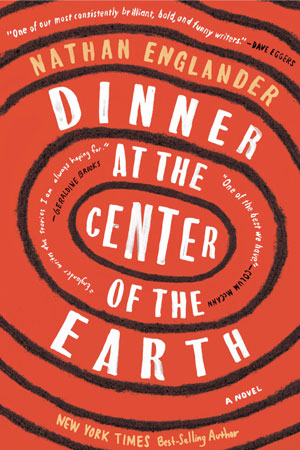
Heartbroken by the conflict, Nathan Englander investigates the failure of solution in his second novel, “Dinner at the Center of the Earth.” Unlike his previous short story collections (“For the Relief of Unbearable Urges” and “What We Talk About When We Talk About Anne Frank”) and novel (“The Ministry of Special Cases”), Englander’s latest work, not unlike his subject, defies categorization or genre. A plot-driven political and spy thriller, a love story, a farce—this novel is an admirable literary combination but fails to compel. The humor falls flat: what’s the joke and where’s the punchline, I thought. The dialogue, despite a few enticing passages, is stilted, wooden, even cliché. The discontinuous timeline and various threads Englander attempts to interweave are strained, rushed. The fits and starts, so to speak, never resolve. Continue reading “Staff Book Review: Dinner at the Center of the Earth”
Tragedies scatter about our lives, usually. If a decade or more separates one loss — a job, a parent, a home, a pet — from another, is what’s lost a tragedy?
For others, losses accumulate, completely warping their understanding of the world. In her articulate tragicomic memoir, “The Rules Do Not Apply,” Ariel Levy recounts the dissolution of her marriage, her miscarriage and her move from what she thought her permanent home — all lost over three months. Reading this challenges one’s sense or definition of tragedy. Continue reading “Staff Book Review: The Rules Do Not Apply”

Book I Listened To: “NOS4A2” by Joe Hill
Why I Checked It Out: I’ve listened to a couple of other books by Hill and enjoyed his storytelling — a blend of fantasy and suspense, with a touch of horror. I also recently listened to his book “The Fireman,” which was also narrated by Kate Mulgrew and I fell in love with the way she reads a story (more on that later!). Continue reading “Staff Book Review: NOS4A2 by Joe Hill”
Book I Read: “Company of Liars” by Karen Maitland
Why I Checked It Out: I regularly read from a variety of genres and had a craving for something historical. I hadn’t visited the Middle Ages lately during my literary travels, so it seemed like I was due for a visit. The mix of religion and superstition that were such driving factors in people’s lives during that time period fascinates me, and I’m also intrigued by the day-to-day challenges people faced in a world that lacked the modern day conveniences I take for granted. In my search for a Medieval tale, I stumbled across Karen Maitland’s book, which was billed as a take on Chaucer’s “Canterbury Tales.” It seemed like just the thing to cure my reading craving. Continue reading “Staff Book Review: Company of Liars by Karen Maitland”

“Late one evening towards the end of March, a teenager picked up a double-barrelled shotgun, walked into the forest, put the gun to someone else’s forehead and pulled the trigger.
This is the story of how we got there.”
I have said it before, but I will say it again: Fredrik Backman has become one of my favorite authors! And he definitely does not disappoint with “Beartown.” I have to admit that I was a little hesitant with this one: the story is set in a hockey town and centered around the sport. I’m not a huge sports fan to begin with, and I grew up with football, not hockey. But the story is more about the community of a sports town and what that means, both the good and the bad. Continue reading “Staff Review: Beartown”
As a young adult, I sometimes feel like a fraud — a kid just playing pretend at being a grownup. I think most people have feelings like this occasionally, but the unnamed narrator in Gillian Flynn’s latest is a fraud and has made a living at it her entire life. Growing up poor, she and her mother would beg on the streets, and they had an intricate system: they knew who to ask, how to ask, when to embellish and which specific embellishment to use on a particular mark.
As “The Grownup” opens, the narrator makes ends meet by a rather unsavory profession, which she simply calls working in “customer service.” When she gets the chance to work as (read: pretend to be) a psychic, she jumps on it, knowing that her ability to manipulate people would make for easy money. She takes on Susan as a client, a housewife with a rocky relationship with her seemingly evil stepson and a house that appears haunted. Is the narrator finally in over her head? One thing is certain: something malicious exists, but where it originates and what can be done to stop it will keep you guessing. Continue reading “Staff Review: The Grownup”
 As we celebrate Women’s History Month and the many women trailblazers who changed our country and the world, the name of an Associate Justice of the U.S. Supreme Court, Sonia Sotomayor, stands prominently in my mind. This is not only because she’s the first Hispanic and the third woman to serve on the highest court of the land, but also because to reach such a position, she had to overcome a lot of hardship and prejudice. In 2013, Sotomayor published her memoir “My Beloved World,” which quickly became a New York Times bestseller.
Born in the South Bronx to a poor Puerto Rican family, little Sonya began showing the strength of her character at the age of nine, when she was diagnosed with juvenile diabetes and had to learn to give herself insulin shots. Despite being raised in a family that hardly spoke English, Sotomayor was an excellent student – she was her high school valedictorian, graduated summa cum laude (the highest of three special honors for grades above the average) from Princeton and, while at Yale, was editor of the Yale Law Review. Before becoming a Supreme Court Justice (2009), Sotomayor held a variety of positions: a district attorney in the New York County District Attorney’s Office, a partner in a private law firm, a justice of the U.S. District Court, Southern District of New York and, later, of the Court of Appeals for the Second Circuit. Continue reading “Her Beloved World: Sonia Sotomayor”
 I love reading about history, especially histories with unique perspectives! Traditional histories omit so much, and what we know has been carefully shaped by what schools usually teach and promote. The myths these texts create often overshadow the realities.
“An Indigenous Peoples’ History of the United States” is a book that dispels many of the myths surrounding indigenous people, such as the myth that the “New World” was sparsely populated at the time of first contact by Europeans or that their cultures were unsophisticated. The indigenous populations were actually much denser than European societies at the time, and they were “supportable because the people had created a relatively disease-free paradise. There certainly were diseases and health problems, but the practice of herbal medicine and even surgery and dentistry, and most importantly both hygienic and ritual bathing, kept diseases at bay. ” Continue reading “Staff Book Review: An Indigenous Peoples’ History of the United States”
 You know those writers whose work is so captivating that you’d read their grocery lists? Jennifer McMahon is definitely one of those writers for me. As one half of a pair of sisters, I’m also sucker for a book where sisters play a prominent role, so it’s likely “The Night Sister” would’ve ended up on my bedside table one way or another. If you enjoy mysteries that feature multiple timelines, numerous points of view and the setting of a deliciously creepy house (or in this case, hotel-as-castle), then this book might be for you as well.
“The Night Sister” begins in the present with sisters Piper and Margot receiving the shocking news that childhood friend Amy has brutally slain almost her entire family and herself, with only her daughter escaping. Then the novel turns back half a century to the childhood of Amy’s mother and aunt. Rose and Sylvie live in the Tower Motel, built like a castle complete with tower. Sylvie dreams of escaping to Hollywood and becoming an actress, while Rose is caught up in the stories their grandmother told them of mares, shape-shifting monsters hidden inside regular-seeming people. Continue reading “Staff Review: The Night Sister”



