
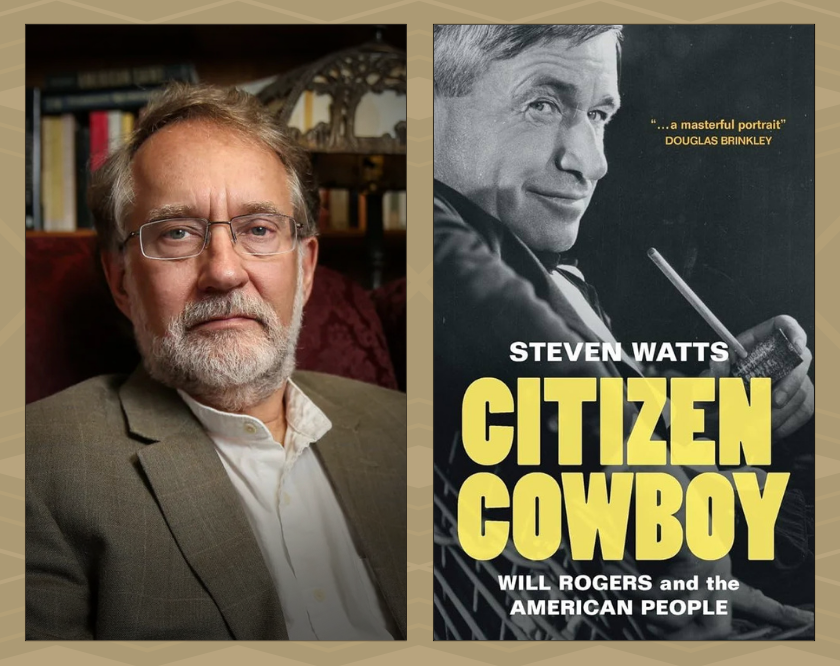
Steven Watts is a Columbia, MO author whose latest book is “Citizen Cowboy: Will Rogers and the American People.” The book details how a youth from the Cherokee Indian Territory of Oklahoma rose to conquer nearly every form of media and entertainment in the early twentieth century’s rapidly expanding consumer society. Watts is Professor Emeritus of History at the University of Missouri and has written many other biographies. He was kind enough to take the time to be interviewed via email.
Daniel Boone Regional Library: Rogers had a lot of creative output during his life. Can you name something that he did (book, movie, column, speech, etc.) that you think is underrated and deserves more attention?
Steven Watts: Actually, no. Will Rogers was one of those unusual public figures who seemed to have a golden reputation on all fronts. From the mid-1910s to the mid 1930’s he was probably the most popular individual in the United States and his newspaper and magazine writing, public speeches, stage appearances, radio broadcasts, and movies earned wild acclaim from most Americans. It’s hard to think of anything he did that was underrated and underappreciated — quite the opposite.
DBRL: Rogers had a tie to Mid-Missouri because he attended the Kemper Military School at Boonville, Missouri for two years before skipping out to work at a ranch in Texas at the age of 19. Was Kemper that different from the other private schools he attended growing up?
Watts: Rogers’ attendance at Kemper for a short time came on the heels of several disastrous stints at grammar schools and academies in Oklahoma. A highly intelligent but ornery kid, he had been kicked out of those schools for bad grades, pranks-gone-wrong, and general mischief making. His father hoped that Kemper, with its military discipline, would bring young Will to heel. It didn’t.
DBRL: It seems that Roger’s Cherokee heritage must have been hard to write about — he embraced that heritage at times, while at other times he downplayed it. What were the most insightful resources that helped shape how you wrote about that heritage?
Watts: In an age when racial and ethnic identity looms so large in the American story, disentangling Will Roger’s views on his Cherokee background was an important task in the book. The task proved especially difficult because of divergent interpretations among earlier scholars, with most saying his American Indian heritage played little role in shaping his mature values and career, while a couple claimed it made him what he was. I relied on three sources to analyze this topic: what Rogers said about his Cherokee upbringing, what actions he took that cast light on this issue, and what family and friends reported about Rogers’ views and actions regarding his identity as a Cherokee. The evidence, in my opinion, supported a clear conclusion. While he clearly treasured his American Indian heritage, Will Rogers viewed himself foremostly as an American and only secondly as a Cherokee. Both played important roles in shaping his world view, but country ultimately triumphed over ethnicity.
DBRL: In the book you briefly write about Walt Disney being friends with Rogers. Since you’ve also written a book on Walt Disney, I’m curious if you have any further thoughts on their friendship. Disney had a few projects that tried to involve Rogers — do you think Disney was more impressed by Rogers than Rogers was with him?
Watts: Rogers and Disney’s friendship was casual and emerged from a mutual love of polo, which both played avidly in the Los Angeles area. But they also formed a mutual admiration society. They were enthusiastic fans of each other’s creative work and were mightily impressed with how each formed a special bond with ordinary Americans in the 1920s and 1930s.
DBRL: What do you think Rogers would think about his legacy? Is there anything that he wanted to accomplish that he had not accomplished before his untimely death?
Watts: He would have been surprised, I think, by how he was fading from American memory by around a decade after his death. World War II, in my view, changed the country and the world enormously in the early 1940s. The enormous loss of life and general destruction caused by that conflict, along with the global realignment and nuclear war issues created by the Cold War, created a very different postwar atmosphere. Rogers seemed like he came from a different time. As for unfinished accomplishments, I suspect the Oklahoman would have liked to do more of what caused his death in 1935 — finding new pathways for the development of aviation.
DBRL: Of all the people you’ve written about, there must have been an interview with someone that eluded your grasp at the time that you later regretted not getting. Which interview would that be?
Watts: While doing my Walt Disney book in the 1990s, I was fortunate to interview quite a number of Walt’s family, colleagues, and staff. I had lined up an interview with Ward Kimball, the bad boy of the Disney Studio and a close friend of Walt’s, but at the last minute he pulled out, saying in his irascible manner that he was tired of talking about the past. He died a few years later, so we never got to chat. That’s a shame, because an interview would have been enlightening and fun.
DBRL: Read anything good lately you’d like to recommend?
Watts: I just finished Erik Larson’s “The Demon of Unrest,” which tells the tale of the confrontation at Fort Sumter between the new Lincoln administration and the seceded state of South Carolina that set off the Civil War in April 1861. Larson is a good historian and a superb storyteller, so the book offers a rewarding read.
DBRL: Where can readers get a copy of your book?
Watts: Skylark Bookshop did have copies, and you can always order one from Barnes and Noble or Amazon. A paperback edition of “Citizen Cowboy,” by the way, will be coming out later this year.