
Full fathom five this watch-list lies
Of its bones are choices (to be) made
Those are smashed pumpkins that were its eyes
Nothing of its options doth fade
But doth suffer a vibe query:
Is it Spooky and NOT Scary???
Apologies to Shakespeare (whoever they were — find out more about the “Shakespeare authorship question” at this link), but I couldn’t resist a little spell-song to celebrate half a decade (!!!!!) of Spooky, Not Scary recommendations. It’s been a horrendous honor and a petrifying privilege to flex my “Y I K E S” muscles in service of my fellow self-appointed Big Babies. 🫡 Here’s to another five fairly unfrightening years!
For those just joining in, I give you the following titles that are avowedly Spooky, Not Scary™. Each title is rated on a scale of 0-5 smashed pumpkins. The more smashed pumpkins (which I’ve metaphorically dropped out of terror), the closer the tv show/movie/video is to being truly frightening.
Note: no gourds were harmed in the making of this list, though some may have been consumed, especially if transformed via kitchen witchery into a baked good evil. 

You can access the full list of this year’s picks volume it’s #5!!! at this link (as well as volume one at this link; volume two a.k.a. boo! at this link; volume threeeeeeek! at this link; and volume oh, the fourror at this link); what follows are some of my not-so-fearsome favs with minimal spoilers.
“The Hunchback of Notre Dame”
Where did your lore start?
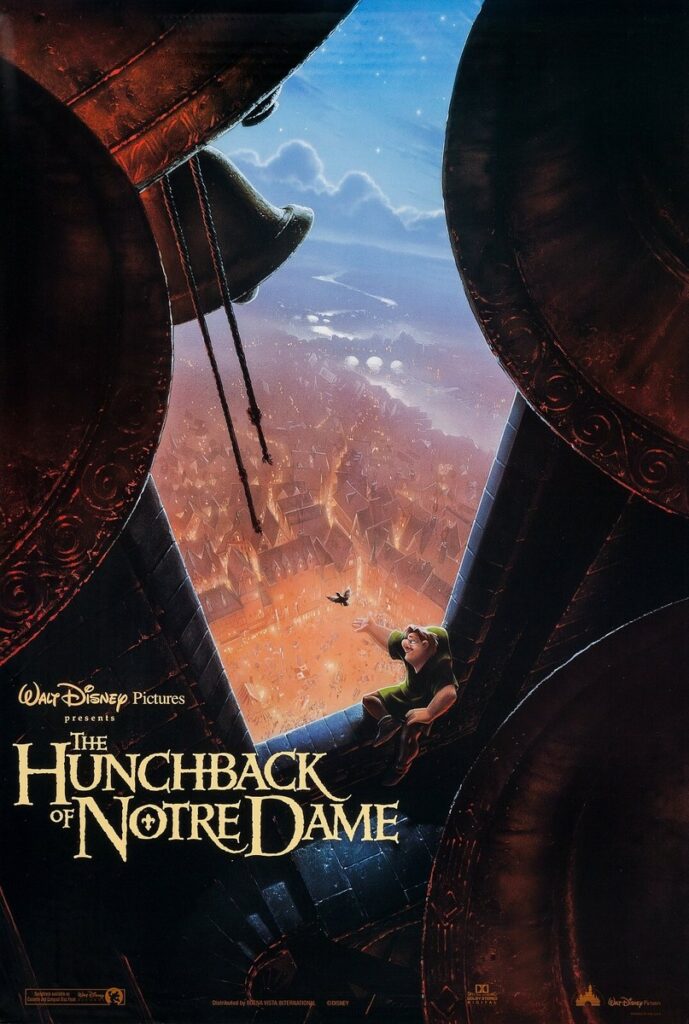
For me, a 90s millennial, two Disney VHS tapes take the cake: 1991’s “Beauty and the Beast” (an OG Spooky, Not Scary recommendation) and 1996’s “The Hunchback of Notre Dame.” (I still have both copies of these 30+ YEARS-OLD videocassettes in my treasured VHS collection if you were curious.)
For those not in the know, Hunchback, as I lovingly call it, is gothic cartoon musical theatre at its finest. The setting is medieval Paris (France — though we see you aspirationally Paris, MO), where we follow the stories of Quasimodo — a disabled man with congenital limb and body difference who is abducted as an infant and forced to live isolated from larger society in the bell towers of the Notre-Dame Cathedral where he works as bell-ringer and earnestly dreams of being a part of quaint city life — and Esmeralda — a Romani* dancer of color trying to keep herself and her people alive in a racist and xenophobic era. These two “outcasts” are united by their compassionate tenderness amidst a cruel and callous world, as well as by how they are abused and hunted by the film’s villain, the most dishonorable Judge Claude Frollo. Frollo is a deeply repressed religious zealot and CREEP who oversees the city’s Palace of “Justice,” which is really just a torture chamber for anyone who disagrees with his genocidal fanaticism. At the center of the story is Notre-Dame herself, gorgeously rendered by the film’s animators, both a spectre and a sanctuary for the film’s characters. She asks early in the film, through the song of one of Esmeralda’s kin, two pointed questions: what makes a monster and what makes a (hu)man? For the answer to her riddle, you’ll have to watch for yourself.
1 – 2 smashed pumpkins for a fairly intense story (for a children’s movie!), with ableism, racism, sexual harassment and weaponized notions of “sinfulness” vs. “virtuousness” all appearing at one point or another in the story. 5000ish/5000ish EYES 🧿 for the “very EYES of Notre-Dame,” which come from the various sculptures and stained glass artworks of saints and other religious figures adorning the cathedral: “You never can run from nor hide what you’ve done from the eyes, the very eyes of Notre-Dame.” #MicDrop
*A note on language: The film and its source material (Victor Hugo’s 1831 novel “Notre-Dame de Paris,” which was published as “The Hunchback of Notre-Dame” in the English translation) both use the word “gypsy” to refer to Esmeralda and her people. This term has historically been used as a racial slur against Romani peoples, who are also called The Roma, and is considered by some to be deeply offensive, which is why I intentionally do not use it here. If you’re curious about the history of how these folks name themselves and have been named, often pejoratively, by others, I would recommend the following resources:
- “The Roma: A Traveling History” by Madeline Potter (2025 historical nonfiction book available to borrow from DBRL)
- “What’s in a Name? What Should You Call Europe’s 12 Million ‘Gypsies’” by Jake Bowers (brief, but comprehensive online article published Sept. 2026)
“Penelope”
Before Chappell Roan donned a prosthetic pig nose and a shimmering red escoffion-esque headdress for the cover art of her 2024 internationally viral single “Good Luck, Babe!”, there was “Penelope,” a charming contemporary fairy tale about a girl — the titular Penelope — who is born with the nose and ears of a pig because of an ancestral curse. While critics were underwhelmed by the film when it came out in 2006 (how and why, I do not understand!), the film has since become a cult “If you know, you know” (#IYKYK) classic.
Through no fault of her own, Penelope is born cursed with the face of a pig until she can find “one of her own kind” who will love and accept her just as she is. In order to protect Penelope from the cruelty of beauty-obsessed “blue blood” society, her parents fake her death and raise her in seclusion until her 18th birthday, when they secretly begin to try to find a suitor from the aristocracy who will be able to break the curse by marrying Penelope. For seven years, Penelope endures the torture of the match-making process, which usually follows the same script: she interviews a rich — and usually insufferably arrogant — suitor from behind a two-way mirror; then, when she finally reveals her face, man after man after man runs from her in horror at the “monster” that emerges from behind the glass. While Penelope’s secret is protected by her parents forcing the suitors to sign a non-disclosure agreement, sweet and naïve Penelope is exhausted by the constant, aggressively over-the-top rejection. When she is rejected for the umpteenth time by a suitor she thought was different than the rest, she decides to end the entire ordeal: wrapping a purple and green patterned scarf around her face (to obscure her unique nose), she escapes (!!!) to finally experience life in the wider world, pig nose and all. But there’s more than one way to break a curse — and more to the final man who ran — as Penelope will discover on her own terms.
0 – 1 smashed pumpkins for gentle whimsy. Really the only horrifying aspect to this cosy and empowering tale is just how MEAN the suitors are, especially because Penelope is actually pretty darn cute WITH her pig nose. #SnoutLove 🐽
“Coraline”
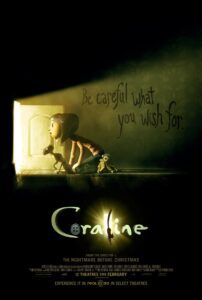
I am late to the “Coraline” fandom, mostly because the film has been filed on my “To Be Scared” list for a long while. But, as one of my besties is always reminding me, I can do hard things! And in this instance, I’m really glad I pushed through my “too scary” assumptions because Coraline, the film, is a spectacular Spooky, Not Scary watch.
Coraline, the girl, is everything you want in a main character. She’s spunky and surly, curious and imaginative, and gives off “when I grow up, I’m going to be a WITCH” energy — which usually comes with a bit of “no one understands me” loneliness. (I understand you Coraline, Patron Saint of Weird Tweens Everywhere.) When her family moves into the Pink Palace Apartments in another state, she’s missing her old friends and wishing her overworked folks had more time for her. Also, that her eccentric new neighbors would stop calling her “Caroline,” UGH!
Unsettled in her drab new surroundings and seeking companionship, Coraline stumbles upon a ragdoll that eerily resembles her, from her blue-black bob to her stylish yellow raincoat and matching boots. (Red flag #1.) Soon after the doll’s appearance, Coraline discovers a small door in the wall of one of the apartment’s rooms. By day, the door mysteriously leads to a dead-end with a brick wall directly behind it. But by night, Coraline discovers an iridescent tunnel that leads to another world, aptly named “Other World” by its doll-like, black-button-eyed inhabitants. (Red flag #2.) Coraline is dazzled by the sights, sounds, smells, tastes and adoration heaped upon her in this Other World. But those of us well-versed in the miraging magic of fairy tales know something is not quite right with this copy-cat trap. (Red flags #3 – 1000.) It will take all of Coraline’s wit, determination and humility to set herself and her loved ones free from the tangled web she has accidentally helped to ensnare them inside.
4 – 5 smashed pumpkins for an ominous story that sneaks right up to the scary line. 5/5 “I told you so” MEOWS from the nameless black feral void of a cat who becomes Coraline’s familiar of sorts, a world-crossing friend through many dangers. #Cattitude 🐈⬛
Spooky, Not Scary™️Strategy featuring MONSTRUM
The world is full of monsters, myths, and legends and Monstrum isn’t afraid to take a closer look. The show — hosted by Dr. Emily Zarka — takes us on a journey to discover a new monster in each new episode. Monstrum looks at humans unique drive to create and shape monster mythology through oral storytelling, literature, and film and digs deep into the history of those mythologies.
Want to know about what goes bump in the night, but from the safe distance of nerdom? 🤓 Then you might like to watch MONSTRUM, a PBS Storied series available to watch FOR FREE on YouTube and PBS.org. Each episode of Monstrum uncovers the history and cultural reception of a monstrous figure from myth and/or folklore around the world. Sure, you’ve heard of Dracula and Werewolves (Part 1 and Part 2), and maybe even Mothman and Baba Yaga. But what about the Yule Cat, Jorōgumo or the Adze? As a Spooky, Not Scary scaredy cat, I absolutely adore learning about all the different kinds of monsters that have haunted and hunted humanity since time immemorial. That way I stay up-to-date in the group chat. 😎