
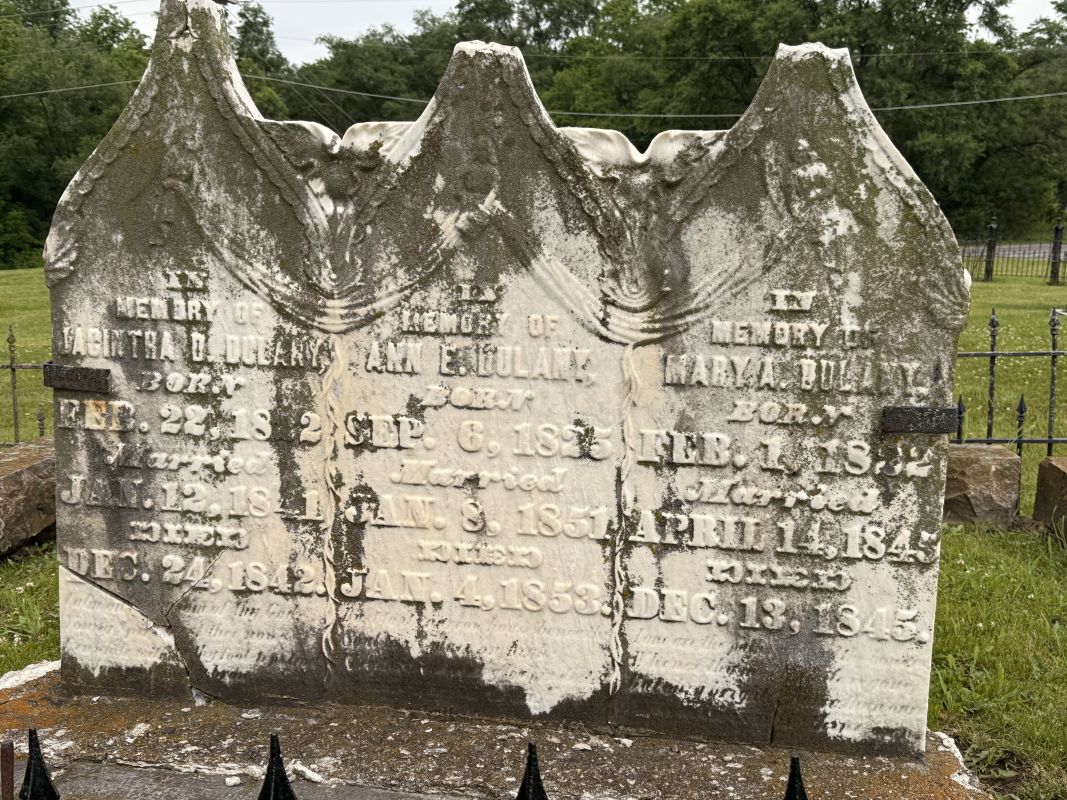
Daniel Maupin Dulany married his first wife, Jacintha Maupin, in 1841, and, in 1853, he buried his third wife, Ann Craig. Wife number two, Mary Ann Thompson, passed in 1845. He later had a memorial stone erected for Jacintha, Mary and Ann at the Founder’s Cemetery in Paris, Missouri; perhaps as he and his fourth wife, Mary, moved to Iowa. I found this memorial stone while out geocaching. I was fascinated. Who were these women? How did they die so soon after marrying Daniel and more importantly, how did they live? Where are their actual graves, as this is a memorial stone? I could find very little information about these three women on Google. So I went hunting.
Primary and Secondary Sources
I have been searching all library resources available here at my home branch, the Columbia Public Library, including our online resources and genealogist Tim D. What enables a person to interpret a happening, of a moment or day or era? The sources you find.
Primary sources are direct, first-hand accounts of an event or topic from those who were directly involved. These can include things like original documents, laws, and newspaper reports written by journalists who witnessed the event or interviewed those who did. Other examples include speeches, letters, diaries, and interviews, where people involved share their personal experiences. Additionally, datasets such as census or economic statistics, as well as photographs, videos, or audio recordings, can also be primary sources, offering raw, unfiltered insights into an event.
The memorial stone is an example of a primary source. If I am able to find a scanned or physical copy of a death record, those would be primary sources.
On the other hand, secondary sources are one step removed from primary sources and typically provide analysis, interpretation, or a broader context of the topic. While they may reference or quote primary sources, they tend to offer deeper insights or broader perspectives on the subject. Secondary sources include most books on a topic, scholarly articles and documentaries (which often feature primary sources like photos or videos). These sources help explain or analyze the events and data presented in primary sources.
A transcribed death record found in local newspapers, church records and personal papers, typed into a document listing all the deaths in Paris, Missouri between 1821 and 1850, is a secondary source.
Ancestry.com is another example of a secondary source that is available within the DBRL libraries. I was able to learn more about Daniel, his fourth wife, his business dealings with his brother William. I learned he had been a sheriff and served four years as a justice of the county court. From Heritage Quest, I found marriage records for both Ann E (1851) and Mary W (1856). No death records, as Missouri didn’t require such records be kept at this time.
A random blog post suggested that perhaps he had killed each of them, some sort of marry/bury fetish and none of the other good citizens of Paris, MO had suspected a thing. But that, my friends, is a rumor.
Indexing and Search Engines
In the Google/Firefox world we live in now, the algorithms control. We know if we type a term into a search bar, the desired results may or may not be found on the first page but if we dig a bit we may hit gold. Or we may need to change our search term and get a new list. A simple algorithm is proximity; ‘John Jacob Jingleheimer Schmidt’ brings page after page of song and story references. ‘John Jacob Smith’ quickly leaves this popular children’s song behind, because the AI’s assumption that you mean the song is overridden by the proximity of the three words together. Placing quotes around the phrase, thus “John Jacob Smith,” asks the search engine to look for those three words together and return those first, so the songs are pushed down in the search results.
The entire process is more complex than that but for this article, let’s stay with that. Before the internet and search engines, indexing was done by humans reading text and making notes of what subjects were within a book. Hopefully very detailed for the book or other items themselves, and more general but still precise for whatever finding aid is being used. An example is the physical card catalog every library had. Research centers would also have ringed notebooks of select topics such as cemetery records and business newsletters compiled by indexers and available for people who walked in the door. They could also look through the manuscript indexes or catalogs, which keeps track of the boxes of papers and other ephemera that people and businesses leave behind.
Records for such finding aids are being brought online as quickly as research centers can find the money to scan the information. For example, Columbia and Callaway Public Libraries have 3-ring binders of obituaries collected by a private citizen; this catalog record helps a researcher decide to visit to view the material. Most libraries, including the State Historical Society of Missouri, have such records in their catalogs. This does not include the information inside of the finding aid and that requires a personal visit to the item.
At other times, the entire item has been scanned and is available. One great example of this is our Community Yearbook Archive, which has almost 100 years of scanned images of all the embarrassing things our elders (or ourselves!) did. And the hair!
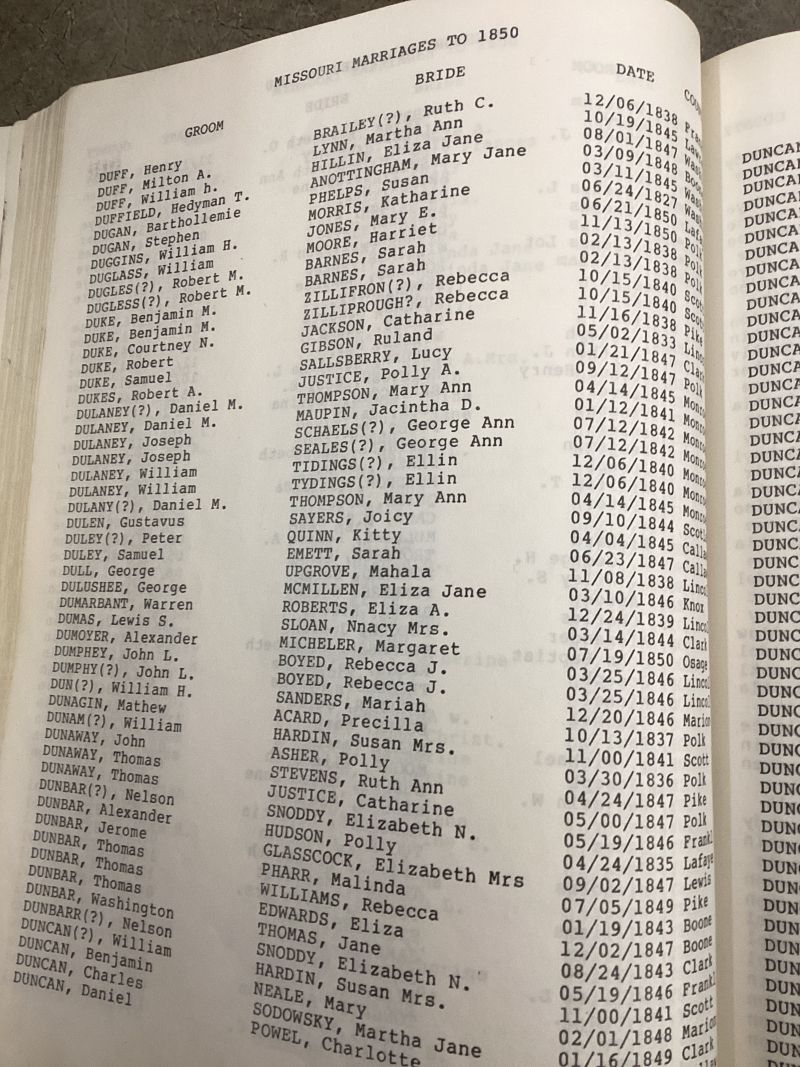
I spent a couple of hours at The Library Center in Springfield, MO turning the pages of numerous, rebound compilations of records from newspapers, official documents and more. Certain of these have indexes but some do not. And some are held at multiple locations, such as Missouri Marriages to 1850 by Linda Barber Brooks, from which I confirmed the marriage dates of the three women I am researching. I also enjoyed skipping through “The History of Monroe and Shelby Counties, Missouri” because it shares an imagined but possibly accurate life of these early settlers. I found a scanned copy on Internet Archives, if you would like to take a peek.
Histories and Biographies
I found an article about Daniel Maupin Dulany in Encyclopedia of the History of Missouri, Vol 2, edited by Howard L. Conard and published in 1901. Daniel’s wives get 10 lines containing names and dates to assure us that the previous wife died before he remarried. Jacintha is misspelled as Carintha, but contemporary sources such as newspapers and marriage records agree with the memorial stone’s spelling.
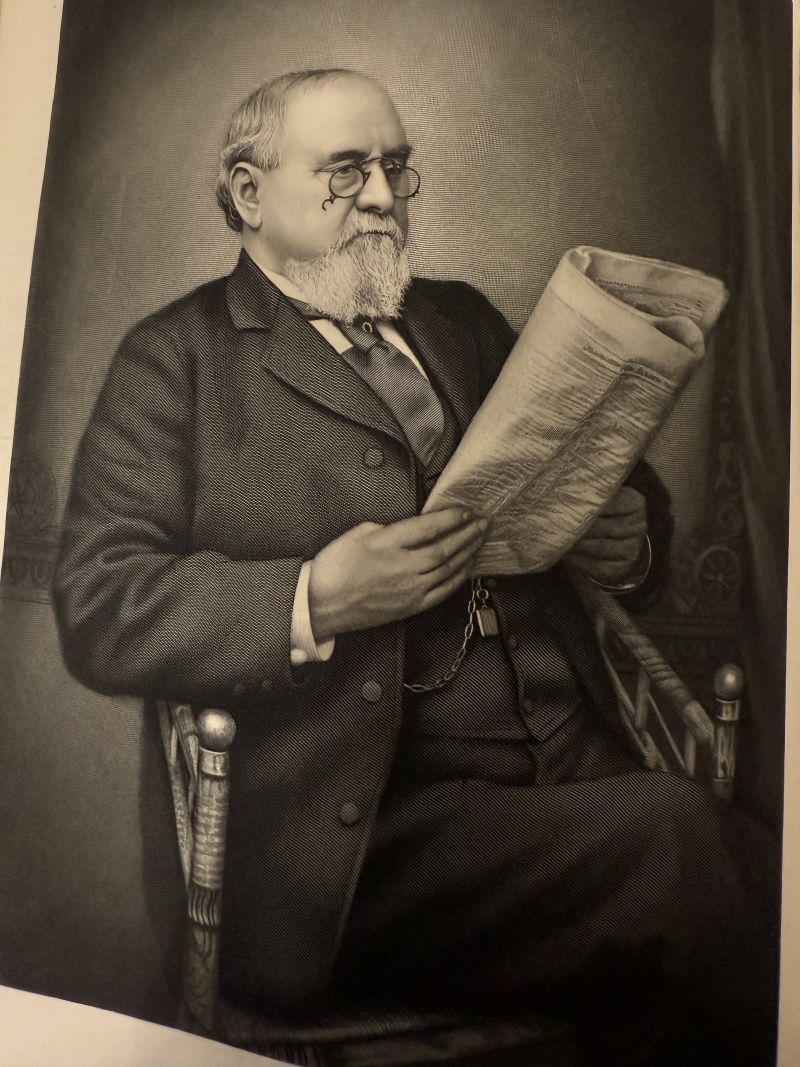
In 1905, Judge Thomas H. Bacon had published “The Mirror of Hannibal,” a life’s work consisting of the accomplishments of the great men of the previous century. Women are listed only in conjunction with their families and their marriages, and Black people not at all. Nor did Bacon cite any of his sources; if I thought that his collected papers might contain information about the women in Daniel Dulany’s life, I might dig deeper.
As unhelpful as this particular tome is in my research, it is a well-regarded history and was revised (and indexed) in 1990. Indexed subject headings and content notes help you find your topic(s). All Hail The Indexers! But better than indexing is a good bibliography. It proves that the source material is verifiable and that you can repeat the research if you wish. Good histories, like Wikipedia, will have bibliographies. Autobiographies are usually considered primary sources.
Newspapers
The Daniel Boone Regional Library does have one newspaper on microfilm that may go far enough back for my research, but I chose to use the online resources at the State Historical Society of Missouri, which contain newspapers back to 1808. I could do that research right in the comfort of my home. Unfortunately, these three women’s deaths were not reported in any newspaper.
Next Steps
I don’t know that I’ve exhausted local resources; while working on this last Saturday, I found a manuscript folder at the State Historical Society in Columbia I should look into. It’s about the businesses of Daniel and William, his brother, but one never can tell what that might lead to. In discussing this project with reference librarian Nina S., I remembered that I found the ministers that performed two of the marriages. So that’s two avenues to explore.
Why am I doing this? Well, it’s a bit of a challenge now as well as giving me the personal experience of how women were erased from our country’s history. I enjoy doing research. And perhaps there will be a longer bit of writing come from this. Who knows?
Lifelong Learning
I love exploring interesting things, and I especially enjoy helping people find information via the library. Do you? There are semi-regular class on lifelong learning resources if you want to come to a formal presentation, or you can come to any Device Advice session. Additionally, I know I’m not the only one here who is thrilled to offer a spontaneous introduction at one of our service desks, although that is usually just a few minutes of time as we do have to tend to the needs of everyone who comes in.
Stay curious and use your local library!