
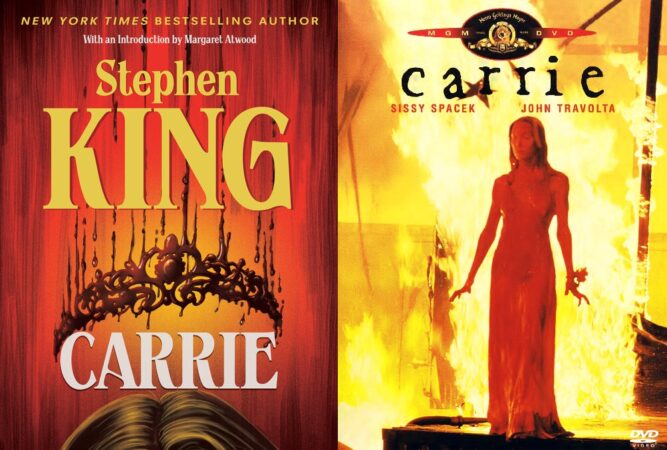
 The contenders:
Stephen King’s 1974 novel “Carrie” and Brian De Palma’s 1976 film adaptation.
The premise:
Carrie White is a lonely high school girl that is bullied by her classmates and abused by her unstable and fanatic mother Margaret. When she experiences her first menstruation at school, Carrie discovers that she has telekinesis, the ability to move objects with her mind. After a cruel prank pulled by one of her bullies on prom night, Carrie decides to take revenge using her powers.
Background:
“Carrie” is one of my favorite horror films. I first saw it when I was 16, and the following day I checked the book out from my school’s library. “Carrie” was what got me into Stephen King’s books and film adaptations. I owe my love of King’s “The Shining,” “It,” “The Stand,” “Salem’s Lot,” “Misery,” and “Doctor Sleep” to the “Carrie” movie and book.
Book versus Screen:
Perhaps one of the biggest differences between the book and film is the epistolary format.
The book is written as if the events of “Carrie” actually happened. The incident in which she massacres the prom-goers and town is called “The Black Prom” of ’79. Investigations, interviews, letters, and and in-universe books about the disaster are referenced in the book. This gives a more grounded, unnerving feeling. Even though it was written almost 30 years prior, it’s reminiscent of 9/11. Meanwhile, the film is a straight-forward narrative with no attempt to persuade the audience the Black Prom actually happened. And while it still has pretty bleak moments, the film is a campy satire with extreme performances and strong, unusual choices in the filmmaking.
Another difference are large, pivotal moments in the book that were omitted in the adaptation:
The movie indicates that Carrie’s first period is what gives her telekinesis, but in reality she was born with it. In the book, the “Rain of Stones” is an incident from when Carrie was four years old and punished by her mother for looking at her sunbathing neighbor. The trauma caused Carrie to summon a rain of ice and stones to pummel the house. This was an indication of her power and the destruction she could bring at such a young age.
The other scene cut was the destruction of Chamberlain, Maine. After the prom massacre, Carrie continues her rampage into the town. She realizes that everyone in town was complicit in her abuse. She pulls off the fire hydrants, unleashes electrical wires, and explodes a gas station to set the whole town ablaze. It adds to the tragedy, but also shows the reality that everyone was responsible for this outcome.
But a substantial difference is the characterization of Carrie White.
Who is Carrie White?
While she is very clearly a victim of abuse and bullying, the Carrie White in the book is very different from the Carrie White we see in every adaptation of her.
From a physical aspect, Carrie is a plus-sized girl. While not necessarily massive, Carrie is a “chunky” girl and hardly the skinny girl Sissy Spacek (and subsequent actresses Angela Bettis, Chloë Grace Moretz, and Summer H. Howell) was in the film. There are more “reasons” why Carrie is bullied, such as her anti-social and awkward personality, and her puritanical faith, but her weight does contribute to the bullying. Margaret fattens her daughter and makes her unattractive in order to be chaste. And she is associated with being a pig, hence why they poor pig’s blood on her, “Pig’s blood for a pig.”
As for her character, this massacre doesn’t come out of nowhere. In the film, Carrie is a pure, kind-hearted girl. When the prank happens, she goes into a sort of trance and regrets her actions once she has calmed down. In the book, Carrie is more disturbed. Shortly after the shower scene in the beginning, Carrie fantasizes of bludgeoning and violently killing her bullies. The prom massacre was also premeditated. Carrie had concerns the prom was a prank and went in with a plan to use her powers if it was. When the prank does happen, she decides to kill her entire class, the townspeople, her own mother and the bullies that caused this incident. She only has one regret in her last moments: killing her mother.
Her behavior is reminiscent of today’s school shooter. Their behavior was a predictor for such a violent outcome — it’s a shock, but never a surprise.
Verdict:
After having watched the 1976 film and reading the book, I find the movie superior.
I believe even Stephen King would agree with this verdict. According to The Guardian, while having a fondness for his first published book, King describes it as “a cookie baked by a first grader — tasty enough, but kind of lumpy and burned on the bottom.” I love “Carrie,” but I agree with his assessment. The book is not as tight and refined as his later works, and it’s riddled with continuity errors.
That said, the book’s epistolary format allows for a more immersive experience, and thus a more disturbing one. It’s raw and occasionally more brutal than his future works. At its core, “Carrie” is about a damaged girl and the dangers that come with bullying and ostracization. King was ahead of his time regarding the nature of bullying and school shootings, made all the more subversive by having the “shooter” be female, as most mass shootings are almost always perpetuated by males.
Despite most people’s grumblings, I enjoy every iteration of “Carrie,” including the 2002 TV and 2013 film adaptations. As a fan of this story, and the horror master Mike Flanagan, I am excited for his miniseries adaptation of “Carrie.” It premieres Wednesday, October 7 on Amazon Prime.
Both the book and movie are definitely worthwhile, and are available at the Daniel Boone Regional Library.