
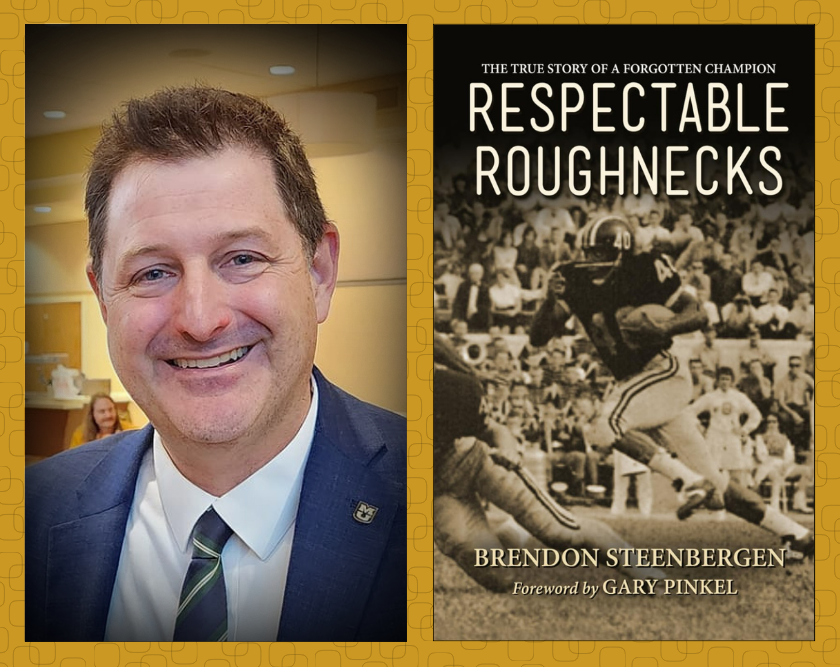
 Brendon Steenbergen is a Mid-Missouri author whose latest book is “.” The book details the story of the 1960 Mizzou Football team — the gridiron struggles, the Civil Rights era battles, and their record breaking and controversial national championship run. A two time Mizzou alumnus, Steenbergen has previously worked with Tiger football recruiting, served as a game-day video replay official for the Big 12 and SEC, and has published the book “Mizzou Sports Through the Ages.” He currently serves as Executive Director for the Missouri Coalition of Recovery Support Providers (MCRSP). He was kind enough to take the time to be interviewed via email.
Daniel Boone Regional Library: Throughout the book you write about the struggles and triumphs Norris Stevenson and Mel West faced as the first black players for Mizzou football. Can you tell us more about how you pieced together their stories?
Brendon Steenbergen: I felt the stories of Mizzou’s first ever Black football players was one of the most compelling aspects of the 1960 team’s story. Both men had passed away when I started working on the book, but I had the opportunity to speak with their widows who were incredibly gracious and generous with their time. I actually have become somewhat close with Norris Stevenson’s family and recently attended a Mizzou game with his daughter.
I think the surprising thing I learned from them was that as challenging as it was to be a Black player in that era, it was equally as tough to simply be a Black student at Mizzou. At that time there were very few Black students on campus. Mrs. Stevenson estimated that there were maybe 50, with most coming from all Black high schools, so the transition would have been dramatic. I was incredibly impressed by the dignity and grace with which Norris and Mel carried themselves through that challenging time and at such a young age. Their story is a reminder that every team and every program has a Jackie Robinson, but many dealt with all of the obstacles without ever enjoying the glory.
DBRL: This book provides support for the movement to reconsider Mizzou’s claim to a 1960 national championship title. What are your top three arguments for it?
Steenbergen: I am a full believer that Mizzou was the 1960 national champion. First of all, if the selection bodies had chosen a champion after the bowl season as they do today, there is no question Mizzou would be named champs. In fact, the events of 1960 directly impacted the Associated Press (AP) and United Press International (UPI) deciding to choose their champions after the bowl. Secondly, when the Kansas loss and then forfeiture are factored into Mizzou’s record, no one else in the country had an 11-0 season. Kansas flat out cheated and the forfeit was well-earned. And lastly, even beyond the win-loss record, if you drill down into the statistics, Mizzou’s defensive numbers were hard to fathom. The team simply shut down everyone they played. Not only were they the best defense in the nation, they were one of the best defenses in history.
I hope one day the Mizzou athletic department will choose to recognize the 1960 team as champions. In fact, one of the official National Collegiate Athletic Association (NCAA) championship selection bodies known as the Poling System has selected Mizzou as champs that year. It’s a legitimate argument.
DBRL: The book is written as narrative nonfiction. How did you decide to develop this approach to the story?
Steenbergen: I realized when researching this season that the statistics and box scores from more than a half-century ago were not the interesting parts of this team. It was the individuals and personal stories that made it compelling. I conducted hours of interviews with the surviving players and their memories fueled me to write the book.
I was also inspired by the book “The Boys in the Boat” about the 1936 Olympic rowing team from the University of Washington that was also told in a narrative nonfiction format. I found it such a vibrant way to bring history to life that I thought it would work well to tell the story of young men that even most Mizzou fans had never heard of before.
DBRL: In the book you also examine the NCAA investigation against the University of Kansas that developed over the Fall of 1960. Can you tell us more about that research? I imagine there were multiple perspectives from that investigation that you had to take into account while writing.
Steenbergen: The funny thing about researching the NCAA and Big Eight Conference investigations was that the bulk of the nitty gritty details actually came from the University of Kansas itself. I made a request to both universities’ archives and got great material from both, but Kansas provided me with hundreds of pages of meeting minutes, letters from angry fans, internal memos from administrators, and newspaper articles about the investigations. It was a real treasure trove. There are hundreds of pages of really interesting details that a true sports history nerd would love to see that never even made the book and is still buried away in my file cabinet.
I also had the opportunity to interview Bert Coan who was the Kansas player at the center of the NCAA controversy before he passed away, and he was incredibly kind and forthright about the situation. I always knew this was a book for Mizzou fans, but I really wanted to be fair to him, because he was really just a kid caught up in a much bigger situation, not to mention a tremendous athlete.
DBRL: You went through a traditional publisher for your first book, “Mizzou Sports Through the Ages.” Why did you decide to go the independent route for publishing your second book?
Steenbergen: I had the opportunity to work with a traditional publisher for my first book, and I’m grateful for that experience. As a new author, their guidance through editing, marketing, and pricing was invaluable. I doubt I could have completed “Respectable Roughnecks” without their support.
However, there was an eight-year gap between my first and second books, and during that time, the publishing landscape changed significantly. A fellow author encouraged me to try self-publishing, and I was surprised by how straightforward and empowering the process was. I had full creative control from cover design to pricing to final edits and complete transparency regarding sales and distribution.
Having now experienced both traditional and self-publishing, I appreciate the unique advantages each offers. Traditional publishing provided structure and expertise, while self-publishing gave me independence and direct connection to my readers.
DBRL: Read anything good lately you’d like to recommend?
Steenbergen: Yes, though not sports related. There’s a great new biography of Missouri’s own “Mark Twain” by Ron Chernow that is as thick as “War and Peace,” but is written with such beautiful simple clarity that it is a breeze to read. I’m also reading a book called “The Man I Knew” about George H. W. Bush that was written by a friend of mine and fellow Mizzou alum, Jean Becker who served as President Bush’s personal assistant. It’s a great story about politics in a more civil time.
DBRL: Where can readers get a copy of your book?
Steenbergen: Of course the book is available at Amazon, but if you’re local, you can always pick up a copy at McAdams’ Ltd. or at the The State Historical Society of Missouri gift shop.