
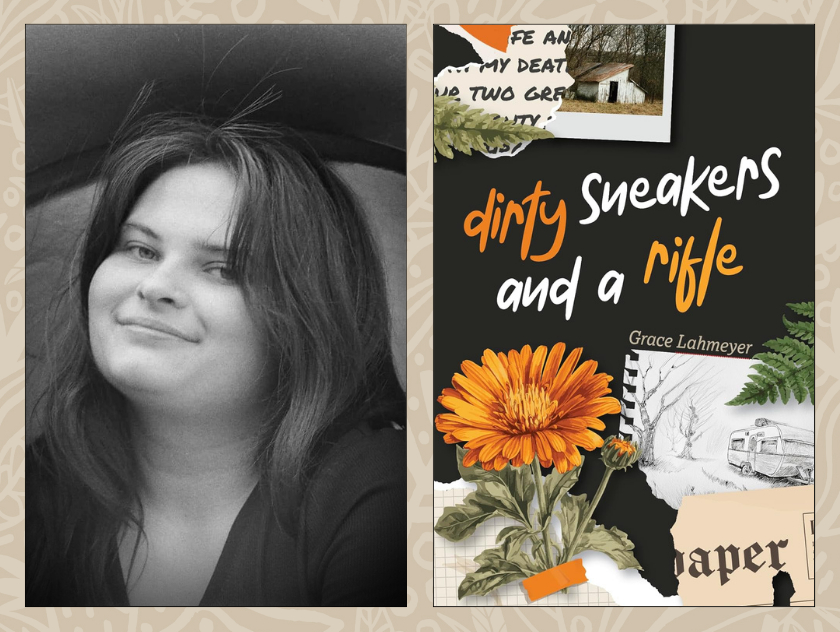
 Grace Lahmeyer is a Mid-Missouri author whose debut book is “Dirty Sneakers and a Rifle.” The book starts months after a post-apocalyptic event, when an orphaned young woman surviving the wilderness in her camper meets an armed stranger who will either bring safety or calamity to her life. When not writing, Lahmeyer is studying for a degree in English education, working on her Goodreads annual goal, or watching her favorite movies with her cat. She was kind enough to take the time to be interviewed via email.
Daniel Boone Regional Library: This book started out as a short story you wrote — can you tell us more about that story and how it came about? What aspect of the short story prompted you to write more?
Grace Lahmeyer: The short story is actually the first chapter of the book. I was bored one day during a class that was basically a study hall in my junior year of high school. During hours like that, I would always be writing short stories based on short prompts from inspiration blogs and such. I believe it took me two days, between other classes that I had free time in, to complete it.
When I was done, I sent it to my favorite English teacher, Ms. Sharlynn Cochran. I sent everything I was proud of to her for critique (I still do, occasionally). She read the short story and demanded more. It left her with so many questions, so many open ends. Under her pleas for more, the second chapter was born. Then the third, then the fourth — so on and so forth. I don’t think my other teachers would be very happy to know how much time I spent during my junior and senior years typing away at it instead of classwork.
I never intended for it to turn into the full-length project that it did. I was just passing the time. The choice to keep the short story as the first chapter only felt natural. Where else could it start? Anything else would seem disingenuous, in a way.
The short story turning into this novel is really a testament to how impactful teachers can be. All down the way, she was my first pseudo-Beta reader. I sent her every new chapter when they were completed; she read them within the day and gave her thoughts. I never would have continued, finished, and been published when I did if not for her encouraging me to continue.
DBRL: The post-apocalypse leaves many of the characters in precarious living situations, and their search for stability and security often seems at odds with their wishes for autonomy and freedom. Can you tell us more about this stability vs. autonomy theme in the book? Did it come up naturally as you were writing or was this something intentionally woven into the story?
Lahmeyer: That theme was something that just came naturally and was completely unintentional. My intended themes revolved more around self-preservation and a lighter idea behind maintaining your humanity through something so traumatic as that. Any other themes that popped up along the way were a natural product of the story and interpretation.
I pantsed a majority of this book (“pantsing” referring to “plotting vs. pantsing”, which is the idea of whether an author writes with a solid guideline of the progression of the story every step of the way, versus if they let the story lead them and make it up as they go along). Both methods work for different types of authors. I had no idea what the actual end goal of it would be until about 60% of the way through. I was going on vague concepts that I knew I wanted to explore. Of course, once I realized the end goal and where the plot would take us, I went back and edited the beginning to reflect it. But most of everything sprouted forth on its own. It was a very fun way to do this book, but I’ve found that when drafting my next projects, I cannot do that again.
What I did intentionally was that similar themes bled through in characters like Chrissy. Chrissy is very set on preserving the Dawson family unit. The three of them, Tate, Diana, and she, are one animal. One machine. To introduce another member was terrifying to her. It would mean a shift to the dynamic that had been so safe and worked so well through all of this instability. I’ve had so many readers dislike Chrissy for being so abrasive and initially unwelcoming to Vivienne, but if my brother showed up with this stranger he found in the woods and started giving her our supplies, I would be a little upset, too. I wrote Chrissy as a rival to Vivienne, but then again, it wasn’t like Vivienne was much better. All she’s caring about in the beginning half is taking care of number one. She’s lying and doubting every chance she gets, and that’s an internal obstacle to overcome. Vivienne and Chrissy aren’t so dissimilar; one of them is just louder and less mature about her objections. In the end, they come to respect each other because they understand each other’s position. They both understood wanting to maintain and protect their own. Those were the types of themes I was more focused on.
DBRL: Do you identify with the protagonist Vivienne the most, or some other character? Vivienne has some useful gardening & plant knowledge — do you have some familiarity with plants as well?
Lahmeyer: I actually didn’t find myself identifying too deeply with any character. It’s difficult to stick identification on any specific characters when all of them come from your brain. I’ll instead say I had the best time writing Dmitri. I always imagined him as the kid in the back of the classroom with his hoodie pulled down, carving in the desk, but he’s an unexpectedly good friend. Vivienne’s friendship with Dmitri was one of the things I knew would happen once he was introduced.
Google became my best friend when it came to Vivienne’s plant knowledge. I chose to surround her with botany because I have such an appreciation for it, and some of my all-time favorite stories surround plants. I wanted to incorporate a little of that here as a practical hobby. Gardening was a way for her to contribute while healing her inner contentment. But personally, my plant knowledge is less practical.
DBRL: Do any elements of the post‑apocalyptic fiction genre annoy you? Which aspects do you enjoy most? Feel free to answer as a reader, a writer, or both.
Lahmeyer: I don’t actually enjoy writing the post-apocalyptic genre so much. I love reading it, don’t get me wrong. But writing in this genre is a different animal than most others. Every genre has its own ups and downs that are suitable for all different types of readers and writers, but post-apocalyptic specifically requires a sensitivity that can be so easy to misjudge. That was a big struggle for me when drafting “Dirty Sneakers and a Rifle”, because I was constantly battling a sort of imposter syndrome. I was constantly worried if I was handling the subject wrong. But I haven’t received any complaints yet, so I consider that a good sign.
As a reader, it annoys me when people use the genre to thinly veil their real-world prejudices into the worldbuilding. This is more so for post-apocalyptic dystopian. So many times, I’ve seen worldbuilding used as a background to carry over stigmas and prejudices that I fear they know they couldn’t portray under any other context. I’m not talking about using conventions of the genre for commentary on certain sensitive topics, but sometimes you read a piece of lore and get an instant suspicion of what motivated the author to make it that way. I try not to draw conclusions like that, but some things do make you wonder if the author thought about the implications, and if they cared about them.
On a lighter subject, it annoys me when the narrative feels the need to be both an apocalyptic piece and a romance. Some things don’t need to mesh, and that’s okay. Don’t get me wrong, it can be done very well. I give props to the authors who figured out the formula to make both elements work. But, in general, I feel like it can be done so wrong if the author doesn’t know how to strike that balance. Then, you can end up in this limbo of which genre takes precedence? Which themes and messaging associated with either genre take precedence?
That’s why I didn’t emphasize her and Anthony’s romance so much. That wasn’t the story I was trying to tell. His involvement in her life was impactful, yes, and he helped her come into a less self-preserving mindset. But their relationship was not the goal of the story. There was a point when I debated making the romance element heavier and spending more time with that, because I am, at the end of the day, a sucker for some romance. But in the end, it didn’t feel right. I would have been trying to mesh two distinct narrative types, and I don’t yet have the skills to do so. Maybe someday.
What I enjoy most, though, is the societies that can bloom out of it. I really enjoy reading different authors’ takes on how societies can rebuild. Whether New York City becomes no-man’s-land or a heavily gated suburbia sets up in the middle of the desert, I love to see how wild and creative it may get. Above all, in my post-apocalyptic books, I enjoy a good nomadic story with found family.
DBRL: Read anything good lately you’d like to recommend?
Lahmeyer: Not read recently, but I will always recommend “Station Eleven” by Emily St. John Mandel. This is a post-apocalyptic novel that follows the fallout of a rapidly contagious respiratory disease. It follows three stories at three points in the timeline, all connected, in one way or another, by one man. The progression between these stories was so well-structured, and the two “side” stories were so interesting.
More recently, I’ve been reading “The Bell Jar” by Sylvia Plath and “The Starless Sea” by Erin Morgenstern. “The Bell Jar” follows a young woman falling into a mental breakdown as her plans crumble. It’s sad, but a classic for a reason. Someone else once described “The Starless Sea” as “a love story to stories”, weaving fables to describe the foundations of an adventure and hidden worlds happening under our noses. They’re both wildly different genres, but I think both contribute to their respective genres very well.
DBRL: Where can readers get a copy of your book?
Lahmeyer: Readers can get a copy of “Dirty Sneakers and a Rifle” on Amazon, and in a couple of independently owned bookstores in Missouri (Bloom and Bindings in Boonville, and BOOK/SHOP, etc. in Jefferson City).