
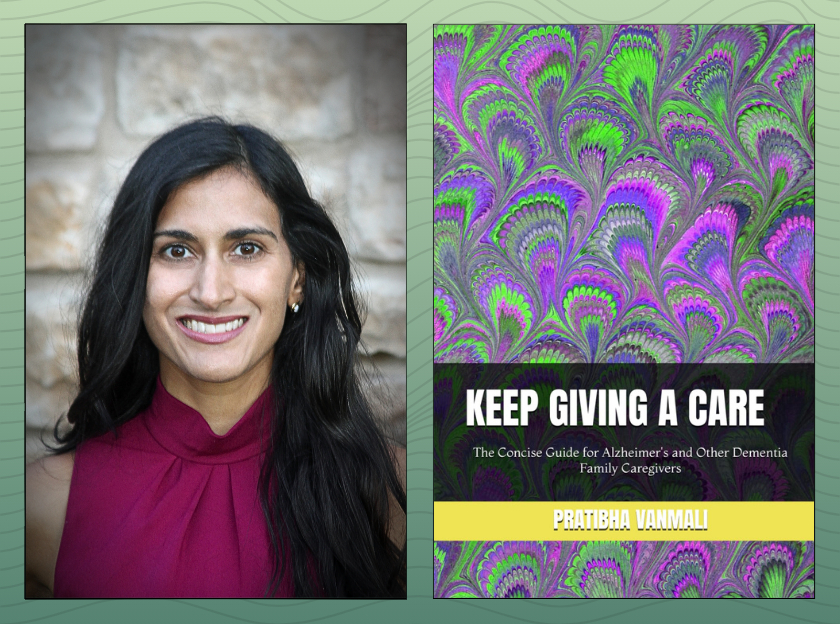
 Pratibha Vanmali is a Mid-Missouri author whose debut book is “Keep Giving a Care: The Concise Guide for Alzheimer’s and Other Dementia Family Caregivers.” Based on her own experiences, the book is a guide for dementia caregivers with effective strategies to make your caregiving journey easier. Vanmali, a graduate of Westminster College, has explored various avenues in work, volunteerism and play since graduating. She was kind enough to take the time to be interviewed via email.
Daniel Boone Regional Library: What prompted you to write this book?
Pratibha Vanmali: After being published in other formats over the years, I’d long envisioned writing a book. I just never imagined it would be this one, especially since I tend to be a relatively private person. But the idea for this book emerged during a conversation with a friend who had just begun her dementia caregiving journey. As I passed along some of the strategies I’d learned over the years and saw her expression relax as we spoke, I realized that many of those lessons were learned without a roadmap. They weren’t obvious to me at the start, yet they became essential along the way. That moment made it clear that drawing on my experience as a writer to share these hard‑learned lessons could ease the path for others by offering clarity, guidance, and comfort to individuals and families navigating this rocky terrain.
DBRL: Are there any misconceptions about Alzheimer’s disease or dementia that you wish more people understood?
Vanmali: A common misconception is that this is just memory loss. Afflicted people do lose memory of events, people, and places; but the reality is far more complex and heartbreaking. Over time, they lose much more than those memories. They lose facets of their core personalities, words, their sense of place, and sometimes, relationships that once anchored them. Eventually, they also lose vital functions, rendering them incapable of safely living independently.
These changes, whether they develop slowly or rapidly, ripple outward and profoundly affect the mental, physical, emotional, and social health of their caregivers. That’s why I wanted my book to offer practical, compassionate support — to not only help caregivers take care of their loved ones, but also of themselves.
DBRL: The stories that you tell in the book are both amusing and informative. What led to this approach with writing the book?
Vanmali: Thank you. There were a few considerations in this approach. Caregivers who pick up this book are already, or will soon be, living through an experience that’s heavy, unpredictable, and often sad. I wanted to offer them moments of lightness and laughter, not to diminish the seriousness of dementia, but to give them space to breathe while still learning something essential.
Humor has increasingly been part of how I’ve navigated my own caregiving journey. I’ve lived the truth of the adage that sometimes, if you don’t laugh, you’ll cry. Blending the amusing with the informative felt natural because that’s what the day‑to‑day reality often looks like: tenderness and frustration, lucidity and absurdity, tears and laughter, helplessness and helping, all tangled together.
My hope was to create a book that felt both useful and companionable, something that delivers vital guidance while also helping readers feel seen, understood, and a little less alone.
DBRL: You briefly mention volunteering at a nursing home when you were a teenager. Can you share more detail about that experience? I’m curious if you feel it had an impact on your caregiving journey later in life.
Vanmali: Good question. Interestingly, that experience didn’t directly shape my views about caregiving. My caregiving role stems more from my upbringing and culture. However, volunteering at the nursing home did leave a lasting impression in a different way. It gave me an early, eye-opening understanding of the isolation that many senior citizens and other marginalized groups quietly endure.
Seeing that as a teenager stayed with me. It shaped how I show up in my community and how I’ve chosen to engage in volunteer work as an adult. While it didn’t predict my caregiving journey, it did deepen my awareness of who gets overlooked, who needs connection, and how acts of presence can matter.
DBRL: In the introduction you imply that you crafted the book to be concise to respect the limited time that caregivers have. Did you write more that didn’t make it into the book?
Vanmali: Actually, yes. I wrote a few additional chapters that I ultimately chose to leave out. My goal from the beginning was to create a concise guide, something caregivers could realistically read and return to without feeling overwhelmed. Caregiving leaves very little time or mental bandwidth, and I wanted to respect that.
Some of the omitted material was also meaningful, but including everything would have shifted the book away from what I intended it to be: a clear, accessible companion that would offer support without adding to a caregiver’s already heavy load.
DBRL: Read anything good lately you’d like to recommend?
Vanmali: Yes. It’s a completely different genre, but I highly recommend “The Handmaid’s Tale” by Margaret Atwood. Even though it was published decades ago, it feels extremely relevant today in the way it echoes and intersects with current events.
What I find especially compelling is Atwood’s intentionality: she made a point to include only technologies that already exist and laws, atrocities, and historical events that have actually occurred somewhere in the world. That choice makes the book hit harder. The result is a story that feels less like fiction and more like a warning — grounded in reality and mirroring patterns we still see playing out in real time. It’s an engaging, cautionary tale that pieces together actual historical precedents into a narrative that’s imaginative and, in some ways, frightfully foretelling.
DBRL: Where can readers get a copy of your book?
Vanmali: My book can be purchased on Amazon as well as through other online retailers. And soon, you might spot it on the shelves of your favorite local stores! I’ve also had a number of Mid-Missouri readers reach out to me directly on Facebook Messenger (Prity Prince) to purchase personally autographed copies, either for themselves or as thoughtful gifts.