
When did you or your kiddos first learn about “the witch” as a cultural concept or storybook character? Who was your or their first witch?
One of the first witches of my early memory appeared in technicolor, a cackle of green and black exploding devilishly out of ruby red smoke.
Another held out a rose in the bitter cold to a petulant prince, a humble gift that, once denied, she transformed into an existential curse.
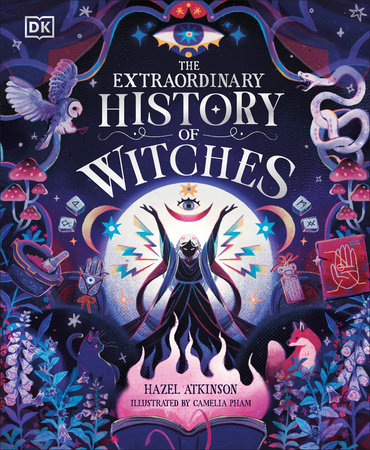
My first witches — the Wicked Witch of the West from the 1939 film “The Wizard of Oz” and the Enchantress from Disney’s 1991 adaptation of “Beauty and the Beast” — are relatively new incarnations of “the witch” archetype. But they are influential figures in a long and turbulent lineage that is as ancient and pervasive as human history. Indeed, as Hazel Atkinson explores in her comprehensive and illuminating book “The Extraordinary History of Witches,” “[w]itches, both real and imagined, are as old as the first civilizations in the world.”
Though I’ve been enamored with — as well as a little bit scared of! — witches since my youngest days, I learned so much from this book, especially about international representations of “the witch” across time and place: from legendary Soledad of Córdoba in Mexico to benevolent Pachamama of the Andes Mountains, from protective Chen Jinggu in Chinese mythology to jolly La Befana in Italian folklore. Besides the witches of myth and fairy tale, Atkinson shares factual stories about real-life humans, many of them women, who were accused of witchcraft or who self-described and knew themselves to be a witch. For example, before reading I didn’t know that Joan of Arc, the 13th century French military leader and young mystic, was officially tried as a “witch” after she was captured and handed over to the English during the Hundred Years’ War.
Overall, Atkinson does a really stellar job foregrounding how the cultural, geopolitical, socioeconomic and even climate contexts of certain time periods deeply affected how the label of “witch” was used and experienced, both oppressive and empowering. Her writing on the brutal chapters of witch history is balanced and honest. Most importantly, she names harmful systems of power, such as colonialism, for what they were and still are, and describes the efforts many marginalized communities have made to protect, reclaim and restore their relationship to witchcraft, spirituality, the natural world and magic.
As a personal bonus, in her chapter on “protective charms,” Atkinson both uses and explains one of my favorite words ever — ✨ apotropaic ✨— which comes to English by means of Ancient Greek from the verb “to turn” and the preposition “away” and describes a kind of energy or object that protects its wearer or conjurer, making Evil™️(or simply bad vibes) “turn away.”
Whether your own list of memorable witches is long or short, there is so much to learn and reaffirm inside these pages — as any witch’s book should be. I highly recommend!