The contenders:
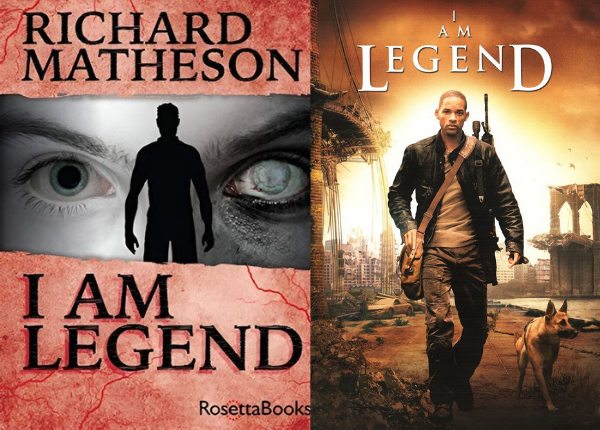
Richard Matheson’s 1954 novel “I Am Legend” and Francis Lawrence’s 2007 film adaptation of the same name.
The premise:
Robert Neville is the last man on Earth after following a vampiric pandemic. He spends his time hunting vampires, providing for himself, fortifying his home and researching the plague. The story’s themes of loneliness, grief and existentialism climax in a twist ending that defines what it actually means to be a monster.
Background:
The book is perhaps my favorite novel. I read it when I was 12 after watching the 2007 film (the third adaptation after 1964’s “The Last Man on Earth and 1971’s “The Omega Man”), which is what got me into the post-apocalyptic horror genre. I owe my love of stories like “The Walking Dead”, “Children of Men”, “The Last of Us”, “World War Z”, “28 Days Later”, and “The Stand” to the book and film. And that’s not a coincidence. George Romero’s “Night of the Living Dead” took inspiration from Matheson’s novel.
Book versus Screen:
The film has some interesting changes. Neville (portrayed by Will Smith) is a virologist in the military. So his knowledge of virology, combat and survival don’t come out of nowhere, whereas book-Neville is an everyman that teaches himself these things.
When it comes to the vampires, part of the horror of the novel was that the vampires had human intelligence. One of the vampires was a friend of Neville’s that every night called him by his name and asked for him to come out. In the film, they are feral monsters. This not only hurts the message of the story, but also confuses people on whether they are vampires or zombies.
And if you didn’t watch this film when it first came out, you might ask “Did the CGI vampires look as bad in 2007 as it looks today?” The answer is yes. The CGI vampires were horrendous, even for 2007. Which is a shame because the film had some incredible and horrifying make-up designs.
The greatest sin of the film is the ending, which is supposed to hold the main message of the story.
The ending (spoiler alert):
In the film, Neville has been researching for a cure. At the climax of the film, Neville finds the cure and gives it to a survivor, Anna, and sacrifices himself in an explosion to kill the vampires attacking his home. This allows Anna to travel to a safe-zone where other survivors are and deliver the cure. She refers to Neville as a “legend” for saving the human race.
This is categorically false.
In the novel, Neville indiscriminately kills vampires by going into their nests during the day while they sleep. Neville is captured by Ruth, a vampire spy sent to apprehend him. She reveals that the vampires are just the same as humans. They’re also beginning to overcome the side-effects of vampirism, such as enduring the sun. The vampires demand his execution, but Ruth offers him a suicide pill. As Neville takes it, he reflects on how the vampires see him, and realizes that this planet will be theirs. When he is gone, he will then become the monster or “legend” among the vampires, the way vampires were legends to us. The book ends with his final thoughts, “I am legend.”
The story’s message is incredibly profound, and asks the reader to consider perspective and not reduce people to absolutes to justify hatred. This was especially groundbreaking in the time the novel was written (around the time of the Civil Rights Movement and the Red Scare), but is even more relevant today.
Verdict:
After reading the novel, the book is superior.
It’s a shame that the most people’s knowledge of “I Am Legend” is the 2007 film that betrays its own message, even though theme is actually present throughout the film and the original ending was closer to the novel. People get frustrated when I tell them about the film’s original ending. It’s almost as if the producers didn’t trust people to handle such a impactful message.
Apparently, there is a sequel film in development — with Will Smith set to reprise his role alongside Michael B. Jordan (who won an Oscar for the vampire film “Sinners”). The insinuation is the original ending where Neville survives is the canonical one. I am interested to see where they go with this and how they honor Matheson’s novel.
The film is still worthwhile, and both the book and film are available at the Daniel Boone Regional Library.